
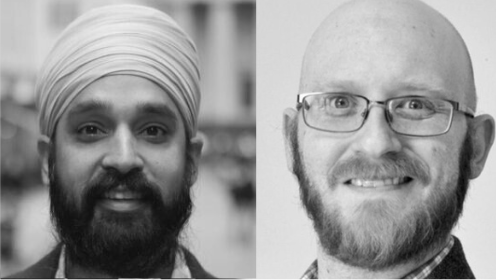
Dr. Simran Jeet Singh is Assistant Professor of Interreligious Histories at Union Theological Seminary and Senior Advisor for the Aspen Institute’s Religion & Society Program. He is the national bestselling author of The Light We Give: How Sikh Wisdom Can Transform Your Life (Penguin Random House), and he hosts the PRX podcast, Wisdom & Practice. In 2020, TIME Magazine recognized him as one of sixteen people fighting for a more equal America, and in 2022, he delivered the opening address at SXSW in Austin, Texas. Dr. Singh earned graduate degrees from Harvard University and Columbia University, and he writes regularly for major outlets, including Harvard Business Review, TIME Magazine, and Religion News Service.
Dr. Aaron T. Hollander is Executive Director of Graymoor Ecumenical & Interreligious Institute, Editor of Ecumenical Trends, and Adjunct Faculty in Theology at Fordham University. From 2022-2024, he served as President of the North American Academy of Ecumenists; he remains on the steering committee of the Ecclesiological Investigations International Research Network and on the summer faculty of the Centro Pro Unione in Rome. He is a scholar of ecumenical theology and lived religion, with his PhD from the University of Chicago. His research focuses on the dynamics of ecumenical/interreligious conflict and coexistence, the aesthetic texture and political power of holiness, and the circulation of theological understanding beyond explicitly religious settings. His first book is entitled Saint George Liberator: Hagiography as Resistance in the Modern Mediterranean (Fordham, 2026).
Aaron Hollander, for Ecumenical Trends: Thank you for being here, Prof. Singh, for this conversation with Ecumenical Trends on your work as an interreligious advocate and educator in light of broader contemporary trends. I’d like to begin, as we often do, with some biographical background for readers who are not so familiar with your remarkable story. Would you share a little bit about the path that brought you to where you are now, as an internationally respected Sikh thought leader and Assistant Professor of Interreligious Histories at Union Theological Seminary?
Simran Jeet Singh: Thank you so much for the invitation. In some respects, actually, my background is not very remarkable after all, being an experience shared by many immigrant families. My parents immigrated from Punjab to the United States, my father in 1974 and my mother in 1980, and they settled in South Texas, which is where I was born and raised. Growing up in San Antonio, my brothers and I were some of the only kids with turbans – there were a lot of implications of this, but one of them was that we learned, pretty early on, that we needed to answer people’s questions about who we were and why we looked so different. And I think that this daily interaction pushed us to have answers that made sense both to us and to other people, which meant perhaps that we had to understand more about our Sikh faith than many other people did about their own cultures and traditions.
Because we were growing up in the diaspora, in a place where there were so, so few Sikhs, I think my parents made an especially concerted effort to preserve our heritage and pass it down to us. And they, along with my grandparents and my uncles and aunts and cousins who would live with us, would spend so much time teaching us Sikh music and language. Punjabi was my only language growing up, until I started school, even though my parents also spoke English. And I’ve ended up doing the same thing for our daughters, as a way of transmitting language and heritage. So this attention to preserving tradition played such a major role in my own formation – giving me a comfort and facility in the Sikh tradition from an early age.
The last thing that I would say, in terms of what put me on this path, was the intensity of racist backlash after September 11. I was a senior in high school, just getting my intellectual bearings at the time, and I could see what was happening to my community: Anyone who looked even remotely like the stereotypical terrorists that haunted American minds was subjected to terrible abuse and mistrust. So I decided I wanted to do something about it, because it was clear to me that a lack of access to power and to our own avenues for public storytelling put Sikhs in a very precarious position. I became interested in the question of how we could start building that social power and attaining that access to platforms and channels and institutions that would help us tell our own story, ultimately creating recognition and a bit more safety for ourselves and for other people. In this respect, I think 9/11 was really the inflection point that put me on the path towards my current work.
AH: Let’s frame that current work, because it’s quite diverse and has a number of interconnected elements. In addition to your role at Union Theological Seminary, for instence you’ve been involved with the Aspen Institute for some time?
I became interested in the question of how we could start building that social power and attaining that access to platforms and channels and institutions that would help us tell our own story, ultimately creating recognition and a bit more safety for ourselves and for other people.
SJS: That’s right. I joined the Aspen Institute a few years ago, and I ran the religion program there. At the time it was called the Inclusive America Project, but we rebranded as Religion and Society while I was leading the program there. My affiliation now at Aspen is as Senior Advisor to the Religion and Society program.
AH: I wanted to ask about the Aspen Institute as a lead-up to thinking with you about the public significance of interreligious scholarship, because so many of the programs there are public-facing and framed in terms of “religious pluralism.” I’m wondering how you would explain what religious pluralism is and why it matters, especially to a skeptic. Of course, we’re living through a time where religious pluralism is under intense scrutiny, and not at all something that can be taken for granted as a civic value.
SJS: I would say that the meaning of religious pluralism, in its most simple form, is the vision of a world in which people of all religious backgrounds and belief systems – including those who aren’t religious – have an equal footing in society. This basic frame requires us to acknowledge first that not everyone in our society has equal access and equal rights, not least on the basis of their religious backgrounds. Pluralism also takes for granted that people should be free to live and believe and practice religion – or not – in whatever way they choose, so long as it doesn’t harm others or infringe on their rights. I think that would be the way that I would begin to describe the idea.
But to answer your question in a different sort of way – how would I explain religious pluralism in a way more vivid and persuasive than the sort of theoretical or textbook definitions that we often fall back on? Because these definitions don’t tend to move people – they sound nice and fine, and people might agree with them in principle, but the sad truth is that we don’t really give them the importance and urgency they deserve. If I’m instead able to help people (including those who are skeptical about religious pluralism) to step into my shoes just briefly and understand what it’s like to be denied rights – this approach tends to be far more effective in moving people toward understanding the issues that people face in the real world, understanding why religious pluralism is not just an abstract good but an essential framework for human dignity in our society.
AH: That’s helpful. This narrative approach or testimonial approach has been gaining ground, certainly in intra-religious ecumenical spaces (like the Global Christian Forum) as well as in the interfaith or public religion field. It’s promising, I think, not only because of its potential to promote empathy among the general public (particularly if they hadn’t already been considering the perspectives of religious minorities), but also because of the way that it clarifies the motivation and positionality of the people who are more actively involved in ecumenical or interreligious engagement. We might come together because we believe that we belong together, that we have some sort of relationship that needs to be maintained and cultivated or rectified if it’s been a relationship soured by a history of violence or a history of mistrust. But how do we do that in a way that really honors and upholds why we ourselves are there? Not just on an abstract or collective historical level, I mean, but in terms of how we can ensure that it does matter to us while also articulating these personal commitments in ways that may be surprising or illuminating to one another.
At Graymoor’s three-week intensive summer course on ecumenical history and interreligious dialogue, which we offer at the Centro Pro Unione in Rome, one of the things that always comes up when thinking about religious pluralism is the difference between the sort of rights-based social pluralism that you’ve been describing, indicating the equal hearing and equal footing of religious communities in society, and what we might call theological pluralism, in the sense of holding that truth is multiple and perhaps irreconcilable in its multiplicity. Our students often come to the course worried about the social pluralism – energetically engaging and defending religious diversity as a welcome feature of society – because they are not able to sign off on the theological idea that there is no ultimate master truth (ours) into which religious diversity can resolve. Sometimes these worries are based on caricatures about “pluralism” (that it means everything is as good as everything else and there’s no way to judge the merit of religious ideas or moral preferences). But is it a fair concern that the social pluralism of equal rights and equal footing for religious communities can lead to a frightening open space of theological pluralism, in which we might learn more from one another but ultimately find ourselves without a firm foundation?
SJS: I do think that the very nature of being human requires us, at least to some degree, to confront the possibility of multiple truths. At an everyday, subjective level this is obvious, right? If you are sitting in your office with your AC on, and I’m sitting in a car with the windows open in the summer, your reality is cold and mine is hot, and those two things are both true at the same time, because the contexts of our experiences are different. In a less trivial sense, though, even those who are the most averse to the idea of multiple truths have to acknowledge that our subjective reality, the knowledge and assumptions we are exposed to, and our sensory experience framed by specific biological and cultural realities, are part of the truth that we affirm, whatever that is.
AH: In other words, we (as human beings) have no grasp on a truth that is not framed by the human mind, which is context-bound, organic, historical, and so forth – even if we might speculate or postulate that there is something beyond this grasp on the truth to which we do not have access? For what it’s worth, this is not a loosey-goosey postmodern idea – to name just a starting point in my own tradition, great Christian theologians like John of Damascus understood this very well: “If you are curious about God, first tell me of yourself and the things that pertain to you.”1 Our capacities for truth-knowing and truth-telling begin with what we are (as biologically and culturally bound creatures) and who we are (as subjective beings with particular points of view from particular horizons and particular repertoires for cognizing and verbalizing experience).
…even those who are the most averse to the idea of multiple truths have to acknowledge that our subjective reality, the knowledge and assumptions we are exposed to, and our sensory experience framed by specific biological and cultural realities, are part of the truth that we affirm, whatever that is.
SJS: Right, and so I think if we can reflect on these contextual aspects of our experience and understanding honestly, moving beyond our insistence that there is a singular answer to every question and a singular truth that we can always point to (which, by the way, is also acculturated), I think this unlocks a different kind of possibility for learning from one another. But then the challenge becomes – and this is the one that I’m grappling with myself, to the extent that I’m not even quite sure how to say it – that we are still confronted with forms of theology and religion, common and familiar and quite vocal forms, that depend for their self-intelligibility on truth claims that are singular and exclusive. To be able to say “I’m right and you’re wrong about what matters most” is really important to many people – and as much as these kinds of claims have shown themselves historically to be very dangerous at times, leading to extremism, they are part of people’s experience, their horizon of meaning. It’s not malevolence, it’s how people often locate themselves in the universe.
So what I’m grappling with is the question of what happens when I say that there is a plurality of truths that can be known better through dialogue but that do not ultimately resolve into a single, universally adequate explanation – and then, as one of those plurality of truths, someone takes a hard-line, exclusivist position like this? How do I respond to positions that I don’t think can contribute to a thriving pluralistic society – like proselytization agendas or racial hierarchies – without invalidating my own position on the fruitfulness of real diversity even on fundamental issues? How can I honor their understanding and experience while still giving voice to why I think they are wrong about what’s needed in society?
AH: I so appreciate this, because you’re naming one of the other issues that always comes up in our summer course when we discuss pluralism: this sense that we bump into a paradox of tolerance when we remove the certainty of our own absolute correctness to make room for the multiplicity and subjectivity of the truth that we can cognize as human beings. Must we be tolerant of intolerance, in order not to be hypocritical? But of course, as with the paradox of tolerance in philosophical ethics, it’s not really a paradox in the end: Karl Popper’s famous insight is that genuinely unlimited tolerance of intolerant ideas will lead eventually to an evaporation of the conditions for the possibility of tolerance, because intolerant ideas will overtake and eliminate those with which they disagree; so the sustainable position requires having boundaries on what can in fact be tolerated.2 So too with theological pluralism, I would think: Holding to the idea that truth is larger than our human grasp on it does not validate any position being as good as any other, particularly when some such positions seek to compel and obliterate rather than upbuild and liberate.
SJS: Exactly.
To be able to say “I’m right and you’re wrong about what matters most” is really important to many people – and as much as these kinds of claims have shown themselves historically to be very dangerous at times, leading to extremism, they are part of people’s experience, their horizon of meaning. It’s not malevolence, it’s how people often locate themselves in the universe.
AH: Now, while we’re still speaking on this broader, religion and society wavelength, I want to ask you a little bit about your book, The Light We Give: How Sikh Wisdom Can Transform Your Life. Specifically, I’m interested in how the book addresses a category that I fear is getting especially short shrift in America at the moment – at a time when soundbite-sized videos and point-scoring, polarizing rhetoric are a prevailing means of information consumption. You write about wisdom. So how does wisdom differ from, say, good policy decisions or interfaith collaboration for the common good? What does wisdom offer (that mere information or knowledge cannot) in an interfaith setting specifically, or as part of what it means to cultivate a thriving society?
SJS: I love this question. It’s one I think about a lot, because of my position as a scholar, because of my attempts to live as a Sikh, and also because of precisely what you describe – the deemphasis of wisdom in our society today. We tend to privilege information and knowledge, as if that will lead to our salvation. The difference between knowledge and wisdom, though, is experience. If we just read about ideas in books and never practice them, and never embody them, then what force do they really have? I love that wisdom comes in different forms, from different histories and different lived experiences, and that we can learn from all of them on what it means to live a good life.
And yet, thinking about how we talk about religious diversity generally, I find that so many people are closed off to one another’s perspectives. Even those who genuinely believe that they’re open-minded and open-hearted can be closed off to taking real insight from their encounters with difference because they feel threatened by the possibility that what they uncover will destabilize what they already have. This is so different from how I’ve experienced the world: I’ve been endlessly enriched by the experiences that I’ve had with people of all backgrounds, not least because, so often, these experiences provide a frame for my own sense of self that brings my unconscious assumptions into the light, helping me see myself a little more clearly. The wisdom traditions of our world’s religions, thought about in these terms, offer something along these lines: a space for deep learning that isn’t just about new information but about a recontextualization or a revitalization of what I already thought I knew.
Holding to the idea that truth is larger than our human grasp on it does not validate any position being as good as any other, particularly when some such positions seek to compel and obliterate rather than upbuild and liberate.
For example, I’m now teaching a course on Islamic history. I’ve taught about Buddhist history. I taught a course on religion and history on Turtle Island, typically known as North America. And there’s a type of learning available in the sacred texts – whether in the Bible, or sayings from the Prophet Mohammad, or Zen Koans, or what have you – that is not just context-bound, not just the facts of what each community has upheld as the meaning that has historically structured its life, but is a site of insight for anyone who comes to it. Wisdom is not exclusive to anyone; if it is wisdom, it can deepen both the understanding of those who have cultivated it in their traditions for millennia and the understanding of those who come to it for the first time. Each tradition will have its own disciplines and practices and ceremonies, of course – these are structures for guiding people along in their lives in community. But wisdom, I think, is so much more expansive than that. Wisdom is a resource for everyone. It really has been my experience that tapping into it can bring us more meaning and clarity into our lives, even when we have paths that we are already following.
Even those who genuinely believe that they’re open-minded and open-hearted can be closed off to taking real insight from their encounters with difference because they feel threatened by the possibility that what they uncover will destabilize what they already have.
AH: I’m hearing echoes here of what you’ve already said about needing to be able to engage with and learn from positions that you might still think are corrosive for society. Can the wisdom-based approach that you’re talking about find room for what we can learn even from traditions that have ethical or cosmological or metaphysical assumptions to which we do not and cannot subscribe? What can we learn from the depths of wisdom within, say, exclusivist or colonialist traditions? And can we affirm this possibility even in the same breath as saying, well, the entailments of certain of these positions have been historically devastating?
SJS: Yes to all. And this is why I love studying what I study. I love teaching multiple traditions, even those that I might find personally objectionable in their ethical or theological claims, because just placing these many perspectives side by side for consideration is enriching. But with my research, too – it focuses on a moment that is not so different from ours today, in early modern North India, which is a confluence of different traditions, linguistic communities, and cultures, all trying to figure out how to live together. They had their challenges, of course, and some of this negotiation of plurality got really ugly. But they also came up with some answers that could really serve to guide us today. Part of what I love about studying different wisdom traditions is that, in our world today, we can be so unimaginative – we can become so stuck in our way of being, and it can be so hard to see beyond our way of doing things, because we tell ourselves the reassuring story that our society is exceptional and we have figured out what other generations in other places could never have figured out. But I don’t think it’s true that no one in the past has found a way through problems that now seem insurmountable to our eyes today. Engaging with history and the many different models that have emerged to address particular moments in particular places can provide us with an alternative approach – not only to looking for answers to our problems, but also to looking at ourselves and the world around us.
AH: I completely agree with naming the necessity of deep historical attentiveness for making sense out of our contemporary interreligious landscape. Now, for the last few years you have held the appointment of Assistant Professor of Interreligious Histories at Union Theological Seminary. Can we talk about this framing of your position as “Interreligious Histories”? It struck me, back when I first saw the posting for this professorship, that interreligious histories is a different framing than, say, “interreligious dialogue” or “interreligious engagement” or “interfaith leadership” or what have you. How do you view the significance of this distinction? You’ve said a little about this already, but why does it matter to you that your teaching role prioritizes a historical wavelength?
SJS: Absolutely. For one thing, I’m trained as a historian, and so when I think about what challenges us in the way we think about religion and the relationships between religious communities today, I see how artificial and provisional the boundaries are that we have created. Such boundaries – this phenomenon is a “Christian” phenomenon, and that phenomenon is “Muslim,” and so forth – are meaningful in that they serve as tools to help us understand something more clearly, but they also obscure reality in some ways. We might try to box up groups of people according to a shared name – saying “Buddhists are like this,” or what have you – but ultimately these kinds of claims will fail because no categorical box can contain the endlessly diverse reality of religious thought and life as they evolve in history. So too, we shape discourse about the history of Islam, for example, as if the community were not being constantly formed and reformed in relation to its cultural context. A historical approach has to take seriously the influences of Judaism on Islam, Christianity on Islam, Hinduism on Islam… and vice versa! It’s not just a disservice not to take seriously these many interlocking interactions and co-formations – it’s also historically dishonest.
A historical approach has to take seriously the influences of Judaism on Islam, Christianity on Islam, Hinduism on Islam… and vice versa! It’s not just a disservice not to take seriously these many interlocking interactions and co-formations – it’s also historically dishonest.
The other piece of this, I think, is that when we tell ourselves stories about how these communities have developed as discrete and easily distinguishable entities, it reinforces a narrative in which these religious traditions at their best are, and should remain, in isolation from one another – “pure” Islam or “pure” Christianity is the version that is looking inward, away from religious others with whom it might interact as a matter of happenstance or conflict. This is historically unthinkable, but very powerful rhetorically. And such assumptions lead to models of understanding – and political practices – in which religions and cultures “work best” when they can be sanitized of their interdependence with and ongoing learning from one another.
AH: This is so important, and I hope that your students are able to get as excited about this as you clearly are. I appreciate how you’re framing this not only in terms of historical accuracy but also in terms of social feasibility. On the one hand, yes, we need rectified models for educating about the history of our religious traditions, which have been distorted by being cast in isolation from one another, on these parallel tracks that can occasionally run close to one another but never actually converge or merge. I think here of Raimundo Panikkar’s notion of “interpenetration” as an alternative framing to that of “exclusion,” “inclusion,” “parallelism,” or indeed “pluralism” between religious traditions – Panikkar recognizes that we actually understand one another’s religious traditions (and our own!) better when we view them through the ways that we have been entangled together historically. These traditions become what they are over time through their encounters with, their debates against, their eavesdropping on, their fear of, and their self-understanding in opposition or alignment to one another. So while it’s easy to say that Christianity doesn’t exist without Judaism, and Islam doesn’t exist without Christianity and Judaism alike, it’s just as correct (even if less intuitive) that there is today no Judaism that doesn’t imply and respond to Christianity, and no Christianity that doesn’t imply and respond to Islam, even if unconsciously. Traditions are molded and informed by these histories of encounter and imagination, by their varieties of life in multicultural societies or frontiers, in ways that are irreversible.3
And, on the other hand – the merit of the approach you’re describing is not only in this power of historical rectification but also in that, by correcting this commonplace vision of religions as hermetically sealed and compartmentalized, we are better equipped for understanding what it means to be in relationship with one another today in a shared society. We’ll have more to say about this soon enough, I suspect.
SJS: I think that’s right. And it’s especially important when coming from a tradition that is regularly marginalized and misunderstood as a blend of sorts between Hinduism and Islam, because yes, the Sikh tradition does emerge out of this long entanglement and contestation between Hinduism and Islam in Punjab, but this isn’t nearly as unusual as it’s sometimes made out to be. The difference is, it strikes Sikhs as very strange to say, of these other religious traditions with which we have intimate historical relationships, “Well, we have nothing to do with them.” Because the Sikh gurus were interacting with their context, and often using the same language and the same visuals that were circulating within other traditions. And yet that sense of pride taken in distance from other traditions is often the attitude taken by religious communities in the modern world, forgetting their histories of relationship and gradual divergence. An interreligious histories approach offers much in terms of understanding both the entanglements themselves and the rhetorics of separateness that work to downplay them.
AH: This is why I so appreciate Panikkar’s perspective on this, because he observes that this kind of interreligious framework is far and away the most realistic, the most historically accurate, but it’s also deeply unsavory and threatening for many people. And that has to be reckoned with. It matters that this sort of anti-syncretic resistance is so visceral in so many traditions – the fear of dissolution or the fear of being insufficiently distinct from our neighbors’ religious intuitions is a key part of the story of how our communities come to be what and where they are.
It matters that this sort of anti-syncretic resistance is so visceral in so many traditions – the fear of dissolution or the fear of being insufficiently distinct from our neighbors’ religious intuitions is a key part of the story of how our communities come to be what and where they are.
While we’re still discussing the interreligious histories framework at Union Theological Seminary, I’m interested in how the interreligious questions are posed there in light of the seminary’s long ecumenical history. Many of our readers will be familiar with Union’s deep and significant history of ecumenical formation and leadership, so it’s fascinating to see how the Interreligious Engagement program at Union is growing and strengthening quickly. I’m interested in hearing how you would understand the place of interreligious studies in terms of Union’s overall task of formation for religious leadership and theological scholarship in an ecumenical key.
SJS: When I was applying for my master’s programs, I applied to Union as well as Harvard Divinity School, and I ultimately chose HDS because Union did not seem to have the resources for someone coming from outside of Christianity in the way that I was. But it’s been about two decades now since I applied. Union has changed, and it is no longer a space where only Christians can successfully pursue formation in religious leadership and scholarship. In fact, Buddhism and Islam are two of the fastest growing programs at Union. And part of what I’m reckoning with here is that there is still an ongoing conversation around the value of interreligious engagement in a seminary setting like Union. Does the existence of this program owe to the fact that it is a valuable opportunity for Christians to interact with people who are coming from other traditions and learn how to navigate those relationships and ideas? This reminds me of the conversations we used to have about race and racism: Let’s diversify our schools so our white students have the chance to meet other people and perspectives and be better off for it. Now, there’s a degree to which it makes obvious sense to center Christianity in a historical seminary setting like Union, but if we are creating programs that form religious leaders who are not Christian, the experience and education of those students matter just as much. I want to be at a place that centers all the people it serves, not just those in the majority.
That’s what I appreciate about Union. The institution is seriously investing not only in interreligious studies but also in Islamic Studies proper, Buddhist Studies proper. Such dedicated programs ensure that the non-Christian seminary students are full participants in the educational life of the institution, not just tokens for the benefit of our Christian students. But the question still remains of whether a seminary is better off for having these programs for forming leaders in multiple religious traditions simultaneously. An analogy might be the arguments about single-sex versus co-ed education. There are some proven benefits to being in single-sex education environments – but whatever these are, there’s no doubt that such segregated environments do not mirror the real world. I think it’s similar for Christian seminary education (or Islamic and Buddhist seminary education, for that matter): it’s possible and even legitimate to isolate oneself and study only among one’s own co-religionists, but what Union is wagering is that students formed for leadership here will be better equipped to engage with and serve the real world in all its complexity, diversity, and entanglement, as the landscape of America’s religious diversity continues to change.
AH: I don’t doubt that this is an ongoing conversation at Union – at the faculty level, the administrative level, and indeed at the student level – one being continually renegotiated. But from the perspective of ecumenics, at least, there’s an essential insight here – that you can’t have religious leadership without interreligious competency, a capacity to understand one’s own tradition and its resources for thought and life in view of their historical interrelationship with other religious traditions and their contemporary implications for a shared local and global civil society. At the same time, as you say, the warrant for interreligious education at the seminary level (insofar as it includes formation for leaders in multiple traditions) has to be grounded in more than this (nonetheless substantial) benefit for the majority tradition.
There’s so much more that we could say on the relationship between interreligious engagement and ecumenical perspective, of course. The histories of intra-religious division and of efforts to establish intra-religious unity (not only in Christianity) are of immense importance both in understanding and in navigating interreligious existence. You can’t really have interreligious engagement without real and sustained attention to intra-religious difference, where it comes from, where it is going – because you never have “Christian-Muslim” dialogue or “Hindu-Sikh” collaboration, you have dialogue or collaboration or contestation between people within different and irreducible iterations of these traditions, who have been formed in particular ways, in the current of particular institutional histories, with particular identities over and against others that claim the same name.4
SJS: That’s correct, and so important. This is something I’ve been thinking about, in light of how much harder intra-religious negotiations of difference can be than dialogue with others not of your own tribe. As someone who identifies with a specific faith community and who also works with many others, I’ve experienced this in so many different ways. Working within the Sikh community is rewarding and important, but it can also be so much more complicated: I don’t always agree with what people in my own community say or do, and they don’t always agree with what I say or do. I think that’s beautiful. It’s part of what makes us human. But people don’t always see differences of opinion as beautiful. Some see them as threatening, or dishonest, or just plain wrong. When that happens in religious communities, it can of course become quite ugly. This is something so many of us have seen and experienced in our own communities – and, as you know, learning how to negotiate this reality productively is at the heart of ecumenical efforts in Christian contexts and analogous efforts more broadly. As a scholar of religion, I’ve been trained on how to navigate people’s competing truth claims, and I try to deploy these skills when these tensions arise. As a practicing Sikh, I have skills and virtues I try to lean into in these moments: humility, listening, non-judgement, and more. But just because I can take a position of hospitable understanding doesn’t mean that I can always convince other people to do so, and so the underlying tension can remain in place.
At the same time, because I belong to the community and care about the community, it’s hard to just let these tensions sit unaddressed. That can take an emotional toll, and I sometimes wonder why it’s worth trying in the first place. But then I remember the importance of the work, the stakes at hand, and also the value of the personal and ethical formation that comes in trying. These reminders help keep me engaged, including in intra-community conversations and activities.
AH: So let me pivot a bit here. The Graymoor Institute, which publishes Ecumenical Trends, is rooted in the Franciscan tradition and the Catholic world, where this autumn we are celebrating the sixtieth anniversary of Nostra Aetate, the Second Vatican Council’s “Declaration on the Relation of the Church to Non-Christian Religions.” As you may know, the reception of this enormously significant document has been somewhat spotty – there are still large swaths of the Catholic Church that remain basically unaware of its teaching, but at the same time it has freed Catholics for interreligious engagement over the last sixty years and equipped them with a firmer foundation on which to engage. There are whole paragraphs, in the short text of Nostra Aetate, dedicated to Judaism and Islam, and rightly so. There are references to Hindus and Buddhists, addressing them appreciatively for their enlightening perspectives on suffering, the divine mystery, the restlessness of the human heart, and so forth. But there is not a single mention of Sikhs or Sikhi. So this brings us back to something you were saying earlier about being in many ways on the margins of interfaith spaces as they’ve been framed and fostered over the last several generations. So I’d like to ask you about what, if anything, you would like to see happening in terms of Sikh participation in interfaith spaces generally or in dialogue with Christians specifically – especially in light of the new papacy of Pope Leo, who has signaled a real continuity with Pope Francis’ approach to ecumenical and interfaith fraternity.
It’s time to interrogate this assumption that the interfaith landscape is perfectly balanced, recognizing instead that Christians remain at the center of a field in which others are welcome to participate but – as often as not – are presented as tokens whose perspectives are ornamental rather than essential.
SJS: Let me give two responses to your question – the first of which concerns what I would like to see in terms of more meaningful Sikh inclusion in interfaith dialogue. Our model of interfaith engagement, in this country at least, has for decades now relied on a pretense of equal footing among religious traditions, which is not quite accurate. It’s time to interrogate this assumption that the interfaith landscape is perfectly balanced, recognizing instead that Christians remain at the center of a field in which others are welcome to participate but – as often as not – are presented as tokens whose perspectives are ornamental rather than essential. This has improved substantially over the last couple of decades, and it’s understandable historically how it came to be the case, but it does lead to real challenges in how we truly engage with one another.
As Guru Nanak, the founder of the Sikh tradition, stated: “Just as the sun is one and the seasons are many, the Creator has countless forms.” I love this teaching, because it calls on us to reframe how we see one another.
Second, in terms of the Sikh-Catholic relationship in particular, I do think we have opportunities for real connection in the context of the current papacy of Pope Leo. One of the challenges that we’ve been facing in trying to cultivate these relationships is that the structures of our traditions are very different. In Sikhi, there are no formal clergy; we don’t have people whose professional or consecrated role it is to represent the community. And so that’s a clear and practical barrier to building relationships at an institutional level. Who from the Sikh community should be invited to be across the table from an Archbishop, from the Pope? So I do think it’s time for those of us who are already invested in interfaith engagement to be a little more proactive and creative around how we can bridge these worlds, in ways that don’t presume that the only functional structure for dialogue is between high-ranking clergy.
AH: Yes, and there’s so much here to think through. It’s interesting to hear you say – correctly, I think – that interfaith spaces and programs have shifted from the assumed priority and central position of Christian voices to something a little more deliberate about uplifting minority voices (in the US context), but then there’s the opposite pitfall that can result from the effort to create a perfectly balanced, neutral space for engagement that has been sanitized of every vestige of historical inequality or marginalization. The question here is: Have we sanitized ourselves out of meaningful reckoning with the complex and painful histories that undergird our present relationships to one another? Does our dialogue, despite its noble intentions of inclusivity, become artificial and fail to engage the messiness of our traditions’ entangled histories?
While we’re thinking about Sikh contributions to the interfaith field – we spoke about how Nostra Aetate has provided Catholics with a key resource for realigning their understanding of other religious traditions and approaching them appreciatively and hospitably to the truth and holiness that they enshrine. What resources do you see in the Sikh tradition that could function in an analogous way as a kind of engine or foundation for interreligious engagement?
SJS: I’ll share here the foundational teaching in Sikh philosophy, ik oankar, which refers to the oneness of all humanity and all of creation. The corollary to this teaching, as it appears in Sikh scripture, is: “If we are all created from the same light, how can we say anyone is good or bad?” Sure, it’s part of the human condition that we break off into tribes, that we create identities, and that we have a sense of in-groups and out-groups. That’s all understandable. But the intervention from within the Sikh tradition is this: What if we didn’t place value judgements on those identities? What if our differences didn’t serve as markers of hierarchy and supremacy, but instead, reminded us of the Divine’s manifold manifestations? As Guru Nanak, the founder of the Sikh tradition, stated: “Just as the sun is one and the seasons are many, the Creator has countless forms.” I love this teaching, because it calls on us to reframe how we see one another. When we start from a place of oneness and connection, then the various theological positions and worldviews don’t need to be in competition with our own. They can just be other forms of divine expression that we can honor and celebrate.
AH: Let me conclude by asking you about something that may not catch everyone’s eye, but I’ve got two kids at home and took notice immediately that, in addition to absolutely everything else that you’re doing, you’re an author of children’s books! So I wanted to ask you about why you carve out time to write children’s books, and about how you approach that creative process of writing not only for the next generation, but indeed for people who in some ways are the most vulnerable, the most dependent in our society, who are going to reap most substantially the consequences of our civic and religious actions today.
SJS: I’d say that there are two primary reasons I write for children as well as for adults, both of which are grounded in a desire to see more Sikhs represented in popular media. In the children’s publishing world, which I’ve become more familiar with now, we talk about “windows” and “mirrors.” Windows refer to the ways that books can allow people to look into an experience that’s different from their own – for me, writing children’s books has a lot to do with humanizing a community that is often seen as inhuman or subhuman in our society. And the second reason is the function of such books as mirrors: helping people who are growing up in these communities to see themselves represented and to internalize the message that their stories matter and their experiences are worth appreciating – whether it’s playing soccer or celebrating a religious festival. There’s a good deal of scientific literature on the importance of shaping children’s moral imaginations early, which is part of it, but on another level it’s just a desire to bring Sikh stories into the mainstream in a variety of genres, children’s literature being one.
AH: I can see that this too is in keeping with the broader sense of religious pluralism as requiring not only the bare existence of diversity in society – requiring only the right for people of diverse traditions and values to be present – but also the normalcy of welcome toward and positive engagement with that diversity in the mainstream. Not only making space physically but also making space emotionally and spiritually for one’s neighbors, making space in one’s identity for a sharing of one’s belonging with others.
SJS: Exactly. Yes, that’s it. You know, religious literacy is a part of why I’m writing for children, but ultimately it’s the same motivation as my teaching and my interfaith advocacy: the hope that bringing these stories and characters forward will help young people to see the humanity in one another. That’s the most important goal for me.
Notes
1. John of Damascus, On Heresies, Epilogue, in Saint John of Damascus: Writings, trans. Frederick H. Chase, Jr. (Catholic University of America Press, 1958), 162.
2. See Karl Popper, The Open Society and Its Enemies, Two-Volume Ed. (Princeton University Press, 2013), 649–52.
3. See Raimundo Pannikar, The Intra-Religious Dialogue (Paulist, 1999), 9–10.
4. Cf., Aaron T. Hollander, “Ecumenical and Interreligious,” in Interreligious Studies: Dispatches from an Emerging Field, ed. Hans Gustafson (Baylor University Press, 2020), 107–18.
This article originally appeared in Ecumenical Trends 54.6 (November/December 2025), a publication of Graymoor Ecumenical & Interreligious Institute. The journal offers distinctive perspectives where the church, the academy, and the interfaith field coincide, and combines reporting on current developments in ecumenical/interreligious affairs with accessible scholarship, interviews, and pastoral reflection on the dynamics of religious difference on common ground. Find out more, and subscribe to Ecumenical Trends (print and/or online), by clicking here.